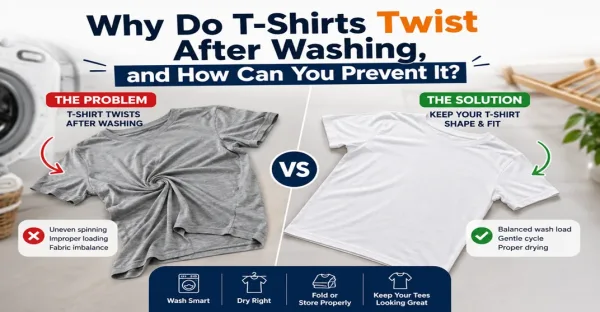
T-shirt twisting happens when yarn tension, fabric skewness, uneven shrinkage, or off-grain cutting affects the garment’s shape. Washing and dryer heat can make these problems more visible. Checking seam alignment, following care instructions, using lower heat, reshaping damp shirts, and testing samples can help reduce distortion and improve long term shape stability.
A new T-shirt may hang straight in the store, then look poorly cut after one wash. One side seam moves forward, the opposite seam shifts backward, and the bottom hem begins to slope.
This lasting rotation is called garment spirality. It can affect fit, comfort, and appearance, especially after repeated laundering. The problem often begins during yarn production, knitting, finishing, or cutting.
For businesses and bulk buyers, early testing also helps prevent inconsistent sizing, customer complaints, avoidable returns, and wasted inventory across uniforms, teamwear, retail collections, and promotional clothing orders at scale.
This guide explains the technical causes, the role of washing, practical care methods, repair limits, and the quality signs buyers should check.
Why Do T-Shirts Twist After Washing?
T shirts twist when the fabric relaxes unevenly during washing. The yarn, fabric rows, or shirt panels may pull in different directions. This can move a side seam toward the front or back. Washing usually reveals a problem already present in the fabric or construction.
What Is Garment Spirality?
Garment spirality is the lasting rotation of knitted clothing around the body. It appears when seams, hems, or panels stop hanging straight after laundering. Common signs include:
- One side seam moves toward the shirt front.
- The opposite seam shifts toward the shirt back.
- The bottom hem slopes instead of hanging straight.
- Body panels rotate when the shirt lies flat.
This differs from clothing tangled inside a washer. Tangling disappears after removal, while spirality remains after drying.
What Causes T-Shirt Side Seams to Twist?
The main causes begin during yarn production, fabric preparation, cutting, or garment construction.
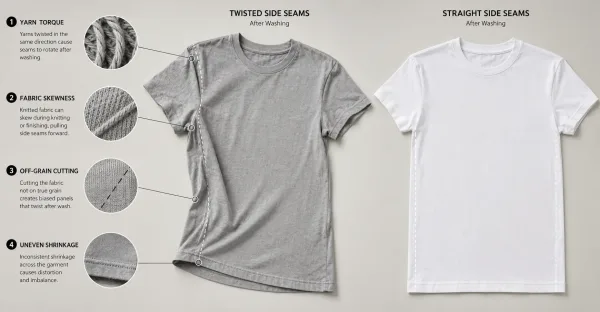
Yarn Torque in Single Jersey Fabric
Single jersey fabric can twist because tension inside the yarn affects how its knitted loops sit.
- Single jersey fabric is built from connected knitted loops.
- Yarn twisting strengthens fibers but may store tension.
- Washing releases tension and lets loops turn sideways.
- This sideways movement can pull side seams forward.
- Yarn direction, fabric weight, knitting, and finishing matter.
Fabric Skewness and Bowing
Fabric skewness and bowing affect how knitted rows align before garment cutting.
- Skewness makes knitted rows lean from straight alignment.
- Bowing makes rows curve across the fabric width.
- Both problems can hide before the first wash.
- Washing may reveal rotation in the garment panels.
- Correcting fabric before cutting improves overall garment stability.
Off Grain Fabric Cutting
Off grain cutting happens when shirt panels do not follow the fabric’s natural direction.
- Front and back panels should follow the grain.
- Misaligned panels may pull toward one side.
- The shirt can look straight before washing.
- Fabric relaxation makes poor cutting easier to notice.
- Careful sewing cannot fully fix off grain panels.
Uneven Shrinkage
The body, collar, seams, and hems may shrink differently. Several production details influence that movement:
- Fabric tension differs across sections after manufacturing processes.
- Stitching tension pulls some areas more than others.
- Collar construction may shrink differently from body fabric.
- Panel direction affects how each section relaxes later.
- Fabric finishing changes shrinkage during repeated laundering cycles.
- High dryer heat can set uneven distortion permanently.
Pre shrunk fabric reduces size change, but it cannot remove yarn torque or correct off-grain panels.
Tubular vs. Side Seamed Construction
Tubular T-shirts are made from a continuous fabric tube. If that tube rotates, the entire garment may develop tubular knit spirality.
Side seamed shirts use separate front and back panels. They can still twist when the panels are skewed or cut off grain.
Neither construction is always better. Fabric preparation, cutting accuracy, and manufacturing control matter more.
How to Prevent T-Shirts From Twisting
Careful buying and laundering can reduce further distortion, although home care cannot repair every manufacturing defect.
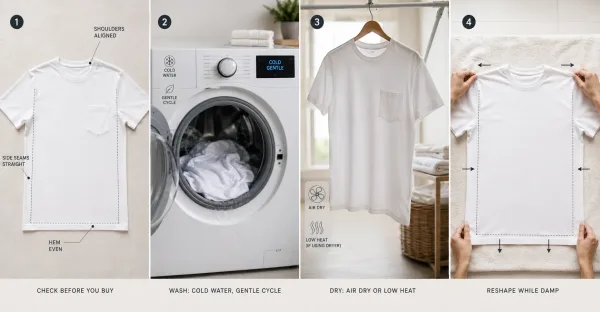
Check the Shirt Before Buying
Before buying, inspect the T shirt carefully on a flat surface to spot early signs of twisting, skewness, or poor alignment.
- Lay the shirt flat on a smooth surface.
- Check whether both side seams remain completely straight.
- Compare both shoulders with the bottom hem alignment.
- Look for grain lines leaning toward either side.
- Confirm front and back panels sit evenly together.
- Review shrinkage information and care label instructions before purchasing.
- Compare several shirts from the same production batch.
Visible skewness is a warning sign. Bulk buyers should wash test one sample before approving high quality wholesale T-shirts.
Wash With Controlled Settings
Follow the care label and use suitable wash settings for the fabric. Gentle washing, proper temperatures, and prompt removal can reduce unnecessary stress and distortion.
- Use cold or warm water when labels permit.
- Avoid aggressive cycles unless heavy soil requires them.
- Wash shirts beside garments with similar fabric weights.
- Turn shirts inside out to reduce surface wear.
- Remove shirts promptly after the washing cycle finishes.
Inside-out washing protects the surface and printed design. It cannot correct yarn torque, fabric skewness, or poor panel alignment.
Avoid Excessive Dryer Heat
High dryer heat can increase shrinkage and set existing distortion. Use low temperature tumble drying when the care label permits it.
Air drying or flat drying places less stress on unstable fabric. However, these methods cannot guarantee that a poorly aligned shirt will remain straight.
Reshape the Shirt While Damp
Align the shoulders, seams, and hem before flat drying. This may reduce mild distortion and prevent the damp garment from drying in a rotated position. It cannot permanently repair severe structural spirality.
How Can You Fix a T-Shirt That Twisted?
Mild distortion may improve, but severe spirality is usually permanent because the fabric structure or panel alignment is already distorted. Try these steps:
- Dampen the entire shirt evenly using clean water.
- Place the garment flat on a smooth surface.
- Align both shoulders and straighten the neckline carefully.
- Move side seams toward their correct positions gently.
- Smooth the body without stretching individual fabric areas.
- Straighten the hem before allowing complete air drying.
Gentle steaming may help the fabric relax. Ironing can flatten wrinkles temporarily, but it rarely removes structural torque.
How Manufacturers Prevent Garment Spirality
Manufacturers control spirality during knitting, finishing, cutting, sewing, and laundering tests.
- Balance yarn twist with the selected knitting direction.
- Relax finished fabric before spreading and cutting panels.
- Correct fabric skewness and bowing before garment assembly.
- Align every panel with the fabric grain direction.
- Control shrinkage during finishing and repeated laundering tests.
- Keep cutting and sewing tension consistent throughout production.
- Measure garments before and after controlled wash testing.
- Compare production lots for dimensional stability and alignment.
These controls improve dimensional stability, which means the shirt keeps its intended size and shape after laundering.
How to Choose T-Shirts That Keep Their Shape
These product details can help buyers judge long term shape and washing performance:
- Choose pre shrunk fabric with clearly stated care instructions.
- Stable knit construction suited for repeated laundering cycles.
- Reliable measurements across colors, sizes, and production lots.
- Reinforced shoulders supporting shape during repeated daily wear.
- Clear shrinkage information provided by the garment supplier.
- Consistent construction across samples from identical product batches.
- Fabric weight appropriate for the intended wearing conditions.
- Supplier guidance covering washing, drying, and garment care.
Pre-shrunk cotton T shirts reduce size change but do not guarantee zero spirality. Ring spun cotton shirts may feel smoother, but finishing still controls stability.
Fabric weight alone cannot prevent twisting. Wash test heavy cotton and athletic T-shirts before approving a bulk order.
T-Shirt Twisting Problems and Solutions
Final T-Shirt Care and Buying Checklist
Use this quick checklist to choose T shirts, reduce twisting, protect garment shape, and improve results after repeated washing and drying.
- Check side seams and bottom hems before purchasing.
- Review fabric construction and product specifications before purchasing.
- Follow every washing instruction printed on care labels.
- Avoid excessive dryer heat during routine garment care.
- Reshape shirts gently while the fabric remains damp.
- Dry shirts flat whenever space and time allow.
- Wash test one sample before placing large uniform orders.
- Compare garment alignment after several complete washing cycles.
Conclusion
T-shirt twisting usually starts with yarn tension, fabric skewness, uneven shrinkage, or poor panel alignment. Washing and drying can make these problems easier to see, but proper care can help reduce further distortion.
Check seams before buying, follow the care label, avoid excessive dryer heat, and test samples before placing large orders. For dependable wholesale T-shirts built for repeated wear, shop The Apparel Factory and choose styles that match your fabric, fit, and performance needs.
Frequently Asked Questions

Published on:
August 11, 2026