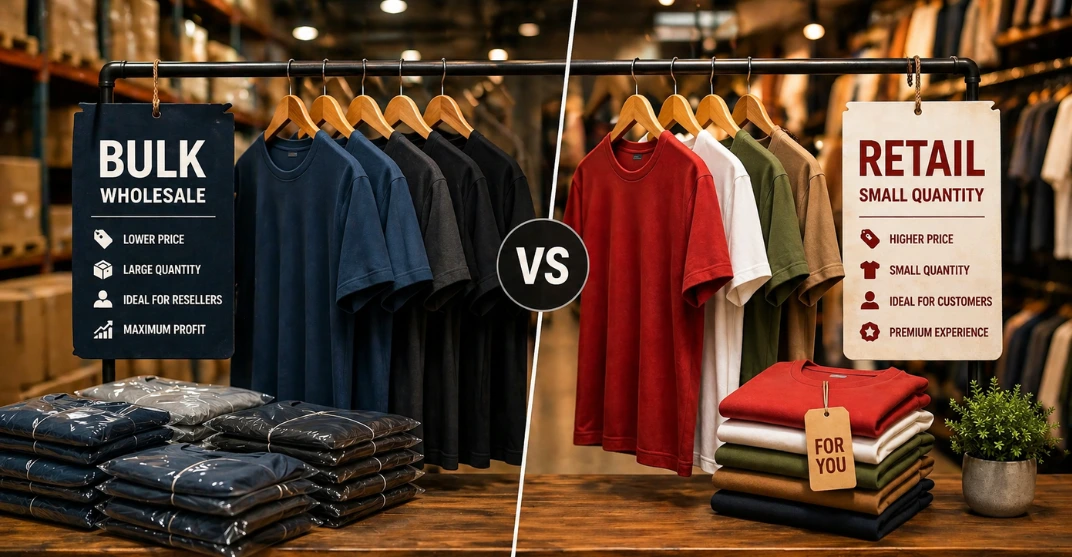
When businesses plan purchases, one question always comes up: bulk vs retail which option makes more sense?
The answer depends on your goals, budget, and how you plan to use the products.
For retailers, corporate teams, and event organizers, the choice between bulk buying vs retail buying affects cost, branding, and operations. This guide breaks it down in simple terms so you can decide faster.
Understanding Bulk vs Retail
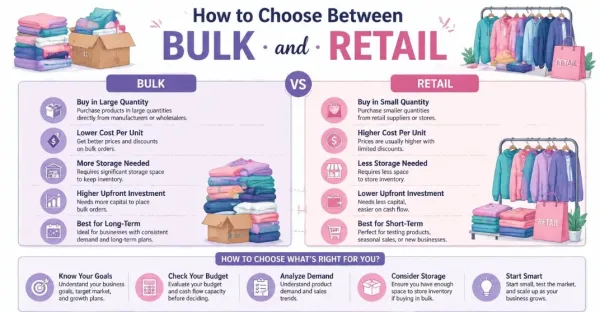
- Bulk buying means purchasing in large quantities at discounted rates for long-term business savings.
- Retail buying means purchasing smaller quantities at standard pricing for immediate or short-term business needs.
In a typical wholesale vs retail model, bulk focuses on large supply for businesses, while retail focuses on individual sales for end consumers and smaller purchases.
For example, a company buying one t-shirt at retail may pay around $15 per piece, but ordering 300 shirts in bulk can lower the cost to $8–$10 per shirt, saving thousands of dollars overall.
Final Insight: In any bulk vs retail cost comparison, bulk purchasing delivers better value, especially for businesses with consistent demand.
Benefits of Bulk Buying for Businesses
Here are some simple benefits of buying in bulk for businesses looking to save costs.
- Cost Efficiency: Bulk orders reduce overall costs and improve financial planning.
- Consistent Product Quality: Bulk ensures uniform sizing, colors, and designs, which is important for teams.
- Strong Branding Opportunities: Businesses can maintain consistent logos and identity through custom bulk t-shirts and uniforms.
- Inventory Planning and Management: Bulk orders support better stock control and reduce last-minute issues.
- Supply Chain Efficiency: Fewer orders improve workflow and reduce operational delays.
Businesses across the US apparel industry rely on bulk purchasing for cost control and consistent branding.
When Should Businesses Buy in Bulk?
Bulk purchasing works best when business needs and long-term goals are clear and planned.
- Demand is predictable, with stable orders throughout the year.
- Products are used regularly in daily operations without frequent changes.
- Branding is important for professional identity, team consistency, and visibility.
- Long-term savings are needed for budget control and cost reduction.
In such cases, businesses can order in bulk, save effectively, and improve efficiency.
When to Choose Retail Purchasing
Retail works better when:
- You need small quantities for short-term use or testing needs
- You are testing products before committing to large quantity purchases
- You have limited storage space and cannot manage large inventory
- Demand is uncertain and future requirements are not clearly defined
For startups, retail vs bulk for small business owners usually begins with retail before scaling operations.
Bulk Buying vs Retail: Pros and Cons
Here are some pros and cons of bulk and retail buying that help businesses choose the right purchasing option based on their needs.
Bulk Buying Pros
- Lower unit cost helps businesses save money and reduce overall purchasing expenses
- Better branding ensures consistent logo visibility across products and strengthens brand identity
- Improved planning supports inventory control and helps manage demand and supply
Bulk Buying Cons
- Higher upfront investment requires more budget planning and strong financial management initially
- Storage requirements increase due to larger inventory and need proper space management
- Risk of overstock if demand is miscalculated and inventory is not managed properly
Retail Buying Pros
- Low initial cost makes it easier for businesses with limited budgets to start purchasing
- Flexible purchasing allows businesses to buy as needed without long-term commitment risks
- Lower storage needs reduce inventory pressure and simplify space management for businesses
Retail Buying Cons
- Higher long-term cost increases overall spending due to repeated purchases at standard pricing
- Limited consistency may lead to variations in product quality, sizing, and availability
- Frequent reordering required adds time, effort, and operational inefficiency for businesses
How to Choose Between Bulk and Retail
To decide how to choose between bulk and retail, consider:
- Product usage frequency helps determine long-term purchasing needs
- Branding needs require consistent designs across all products
- Budget per unit affects overall cost and spending decisions
- Storage capacity limits how much inventory business can handle
Businesses focused on growth usually choose bulk.
Which Is Better: Bulk or Retail for Business?
For most companies, bulk purchasing is the smarter long-term strategy.
It helps reduce costs, improve consistency, and scale operations.
However, retail remains useful for short-term or testing needs.
Bulk Purchasing for Small Business: Smart Strategy
Small businesses can use bulk purchasing as a smart strategy to grow steadily while managing costs and reducing risks.
- Start Small and Scale: Begin with moderate quantities before moving to large orders.
- Work with Reliable Suppliers: Choose trusted bulk apparel suppliers USA for consistent quality.
- Focus on Core Products: Start with essentials like uniforms or branded apparel.
Common Mistakes Businesses Make When Choosing Bulk vs Retail
- Focusing Only on Price: Ignoring long-term value can lead to poor decisions.
- Ordering Without Demand Planning: Lack of planning causes overstock and waste.
- Ignoring Branding Opportunities: Retail limits customization and brand visibility.
- Choosing Retail for Repetitive Needs: Frequent retail purchases increase overall cost.
- Not Partnering with the Right Supplier: Unreliable vendors lead to delays and inconsistency.
How Bulk Buying Supports Business Growth
- Better Budget Control: Predictable pricing improves financial planning.
- Faster Operations: Bulk reduces ordering frequency and saves time.
- Stronger Brand Presence: Consistent apparel builds trust and recognition.
- Scalability: Bulk purchasing supports business expansion.
Industry Use Cases: Bulk vs Retail in Action
- Retailers: Bulk helps maintain stock and improve margins.
- Corporate Teams: Uniforms benefit from consistency and cost savings.
- Event Organizers: Bulk ensures timely delivery and consistent branding.
- Startups: Retail works initially, but bulk supports growth later.
Final Thoughts
The decision between bulk vs retail which option is right depends on your business needs.
- Choose bulk for savings, consistency, and growth.
- Choose retail for flexibility and low-risk testing.
For most B2B businesses, bulk purchasing delivers better long-term value.If your business is ready to reduce costs and scale faster, now is the time to switch strategies. Explore trusted wholesale clothing suppliers, invest in custom bulk t-shirts, and streamline your purchasing process for better results.
Partner with The Apparel Factory to access reliable bulk solutions, high-quality products, and consistent branding support.
Request a bulk quote today and get better pricing for your next order.
Frequently Asked Questions

Published on:
April 29, 2026