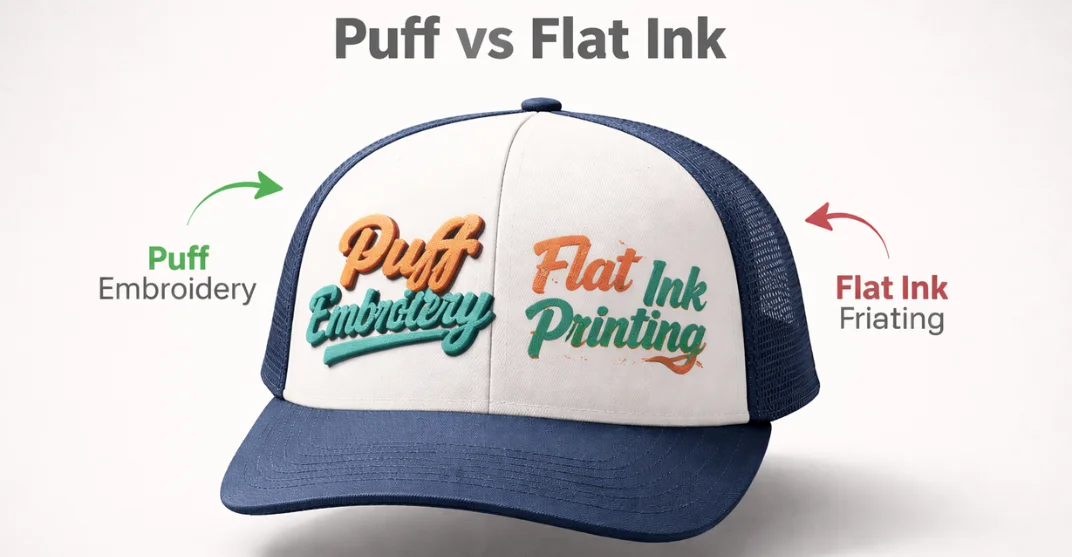
“While both methods are durable, Puff (3D) Embroidery generally lasts longer on trucker hats because the polyester threads are physically stitched into the structured foam, whereas flat ink (screen printing) can eventually crack or peel due to the curved surface of the hat.”
When it comes to the iconic Trucker Hat, the stakes are higher. Unlike a flat t-shirt, a trucker hat has a rigid, curved surface and a foam-backed front panel that presents unique challenges for durability. If you are choosing between Puff (3D) Embroidery and Flat Ink (Screen Printing), you aren’t just choosing an aesthetic you are choosing the lifespan of your brand’s reputation.
In this deep dive, I’ll break down the science of durability, the “50-wash reality,” and why one of these methods is the undisputed king of longevity.
The Anatomy of a Trucker Hat: Why Decoration is Tricky
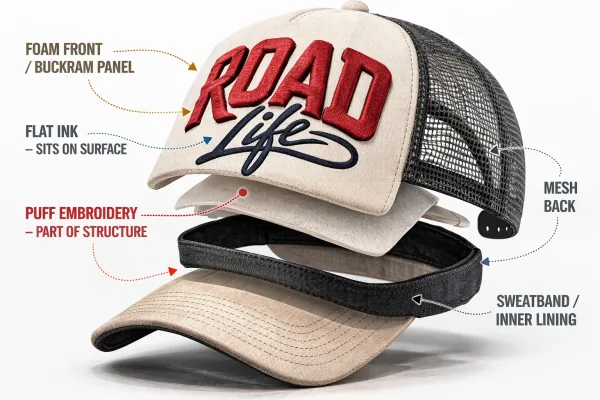
Before we talk about ink vs. thread, we have to talk about the canvas. A trucker hat is a “structured” cap. Most use a polyester foam front or a stiffened buckram fabric to maintain that high-profile “A-frame” look.
When you apply Flat Ink, the ink sits on top of this foam or fabric. Because the hat is curved, every time someone puts it on, takes it off, or tosses it in a gym bag, that surface flexes. For a printer, this is the danger zone. Puff Embroidery, however, interacts with the structure differently. It doesn’t just sit on the hat; it becomes part of the hat’s architecture.
Puff (3D) Embroidery:
Puff embroidery is more than just a “raised” look; it’s a structural reinforcement. In this process, a high-density foam (EVA foam) is placed over the hat, and our Tajima or Barudan machines stitch high-tenacity polyester thread right over it, “capping” the foam inside.
Why it lasts “Forever”:
-
Thread-to-Fiber Locking: Unlike ink, which relies on a chemical bond to the surface, embroidery creates a mechanical lock. The needle punctures the foam and fabric, weaving the design into the material. It cannot “peel” because there is nothing to un-stick.
-
UV and Sweat Resistance: We use 100% polyester threads. Why? Because polyester is naturally resistant to bleach, sunlight (UV rays), and the acidity of human sweat three things that a trucker hat encounters daily. While ink might fade under the Texas sun, thread holds its pigment for years.
-
Impact Recovery: The foam inside 3D puff is resilient. Even if the hat gets squashed in shipping or a backpack, a high-quality puff design “springs” back into shape.
The Expert’s Verdict: If your goal is a premium streetwear brand where the customer expects the hat to look new for 5 years, Puff Embroidery is the only choice.
Flat Ink (Screen Printing):
Flat ink (Screen Printing), specifically Plastisol ink, is the go-to for high-volume, budget-conscious orders. It allows for incredible detail that thread simply cannot achieve (like fine lines or tiny text). But in the battle of durability, it has an Achilles’ heel.
The Vulnerability Factor:
-
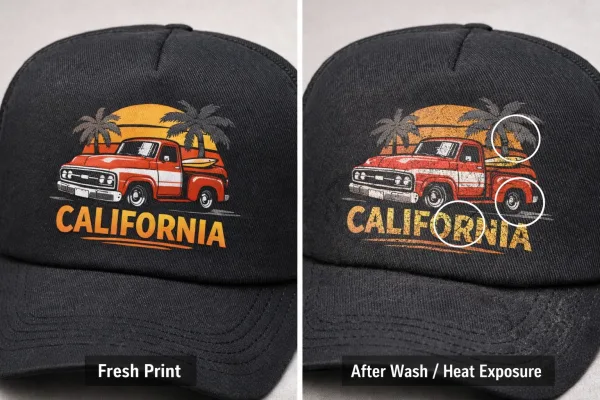
The Cracking Dilemma: Plastisol ink is essentially a thin layer of plastic cured onto fabric. On a soft t-shirt, it’s fine. On a stiff trucker hat, the constant tension of the curved panel creates “stress fractures.” Over time, especially with heat exposure, the ink loses its elasticity and begins to crack.
-
Adhesion Issues: Foam-front truckers are often made of synthetic materials. If the ink isn’t flashed and cured at the perfect curing temperature (usually 320°F), the bond is weak. One bad wash cycle and the logo can begin to “flake” at the edges.
The 50-Wash Durability Test: What Really Happens?
In our facility, we’ve put these through the ringer. Here is the “no-nonsense” result after 50 industrial wash cycles:
-
Puff Embroidery (Score: 10/10): The thread remains tight. There is zero fraying. The only change is a slight softening of the internal foam, but the visual “pop” remains 100% intact.
-
Flat Ink (Score: 5/10): By wash 20, you’ll see “spider-web” cracking. By wash 50, the color has faded significantly, and the edges of the logo may begin to lift from the polyester mesh or foam.
You can also read our The 50-Wash Test guide:
Decision Matrix: Which is Right for You?
Expert Design Tips: Maximizing Your Investment
If you’ve decided on a method, here is how you make sure it stays looking professional:
For Puff Embroidery:
-
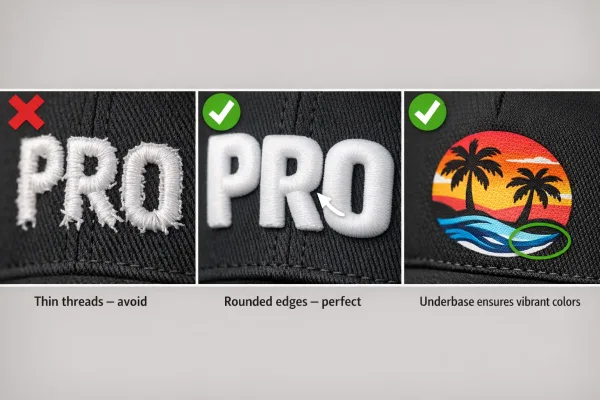
Avoid Thin Lines: Your design elements should be at least 3mm wide. If they are too thin, the thread won’t fully cover the foam, and the “puff” will look messy.
-
Round the Edges: Sharp points in a logo are hard to “cap” with thread. Rounded corners lead to a much cleaner, more durable finish.
For Flat Ink:
-
Keep it Small: The smaller the print area on a trucker hat, the less “flex” it endures, which means less cracking.
-
Request an Underbase: Always ask for a high-quality white underbase if printing on dark hats to ensure the colors don’t “bleed” or fade into the fabric.
Final Thoughts from the Factory Floor
If you are building a brand that stands for quality, invest in Puff Embroidery. The higher upfront cost is offset by the fact that your customer will still be wearing that hat three years from now, acting as a walking billboard for your brand. Flat ink has its place for events and low-cost promos, but for the “Streetwear King” look, the needle and thread win every time.
At The Apparel Factory, we specialize in both. Whether you need the precision of high-speed screen printing or the luxury feel of 3D puff, we ensure your hats are built to survive the grind.
Frequently Asked Questions

Published on:
March 18, 2026