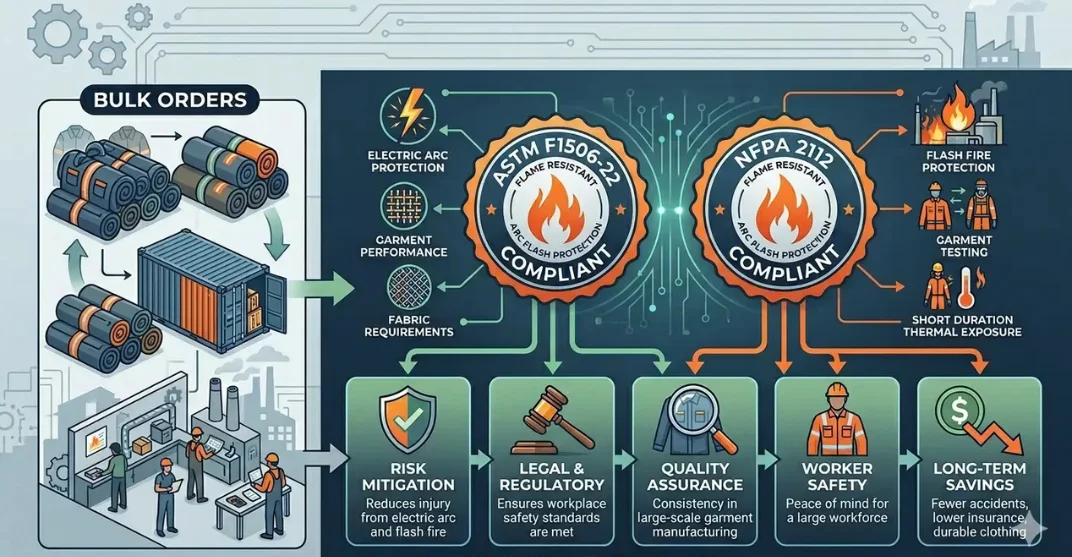
ASTM F1506-22 (American Society for Testing and Materials) is a crucial performance standard that dictates how flame-resistant (FR) clothing protects workers from arc flash hazards. It focuses on arc ratings (ATPV) and thermal performance. In contrast, NFPA 2112 (National Fire Protection Association) ensures protection against industrial flash fires by limiting flame spread and burn injury. Understanding the difference is vital: ASTM F1506-22 is for electrical safety, while NFPA 2112 is for thermal/fire safety. For bulk FR clothing procurement, meeting both standards ensures comprehensive workplace risk management.
Key Takeaway for Safety Managers:
ASTM F1506-22: Electrical Arc Flash Protection (measured in $cal/cm^2$).
NFPA 2112: Industrial Flash Fire Protection (3-second manikin test).
What is Flame Resistant Clothing and Why it Matters
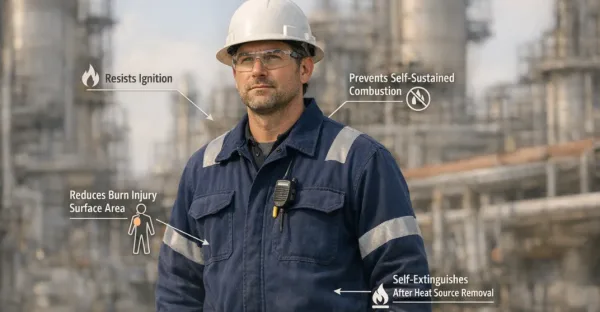
It is specialized PPE designed to resist ignition, prevent self-sustained combustion, and self-extinguish once the heat source is removed. Unlike standard workwear, FR apparel significantly reduces the surface area of burn injuries.
Industries such as Oil & Gas, Utilities, and Manufacturing rely on Industrial Safety Apparel USA standards. When sourcing bulk FR clothing, compliance is not optional; it is the foundation of worker safety. Consistent quality and regulatory alignment ensure that large-scale orders meet OSHA requirements and minimize liability.
ASTM F1506-22 Explained: Arc Flash Protection Standard
ASTM F1506-22 acts as the benchmark for arc-rated (AR) clothing. It ensures that fabrics used in electrical environments won’t melt or drip when exposed to an electric arc.
This compliance test specification includes:
-
Minimum Arc Rating: Defined by ATPV (Arc Thermal Performance Value) or EBT (Energy Breakopen Threshold).
-
Fabric Integrity: Performance under extreme thermal exposure.
-
Mandatory Labelling: Specific data that must be visible on the garment for safety audits.
NFPA 2112 Explained: Flash Fire Protection Certification
NFPA 2112 compliant clothing is the gold standard for protection against short-duration thermal exposures. This is the primary requirement for FR uniforms for oil and gas industries.
This certification evaluates:
-
Flame Resistance: After-flame time must be less than 2 seconds.
-
Manikin Testing: Predicts total body burn (must be < 50% for 3-second exposure).
-
Durability: Fabric must maintain its FR properties after at least 100 industrial launderings.
ASTM F1506-22 vs NFPA 2112: Clear Comparison
Choosing the right gear depends on the specific hazard. While both focus on life-saving protection, their engineering is different.
Why Bulk FR Clothing Requires Strict Compliance
Purchasing bulk FR clothing involves more than just price negotiation. It requires a robust compliance monitoring system to ensure every unit in a thousand-piece order is equally protective.
Key factors include:
-
PPE Safety Standards: Alignment with OSHA 1910.269 and NFPA 70E.
-
Audit Readiness: Maintaining documentation for safety inspections.
-
Management System Compliance: Ensuring the manufacturer follows ISO or similar quality tracks.
Risks of Non-Compliance:
-
Increased fatality/injury risk.
-
Severe legal penalties and OSHA fines.
-
Operational downtime due to safety breaches.
Compliance Systems in FR Apparel Purchasing
Effective systems ensure safety at every stage of the supply chain for bulk FR clothing.
Compliance Monitoring
This involves routine checks of lab reports and UL certifications. Always verify that the “NFPA 2112” mark is clearly visible on the garment’s exterior label.
Management System Compliance
A structured process that tracks batch numbers and fabric rolls, ensuring that the quality of the 1,000th garment is identical to the 1st.
Handling Compliance Non Compliance
If a batch fails, compliance non compliance protocols (re-testing or recall) must be initiated immediately to prevent faulty PPE from reaching the field.
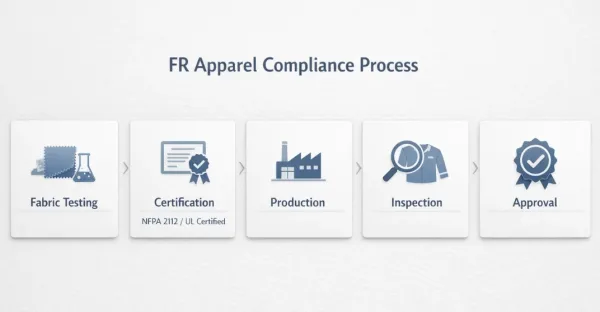
Role of Compliance Test Specification in FR Apparel
A compliance test specification is the technical roadmap used by labs (like UL or Kinetics) to validate FR claims.
-
ASTM F1506: Uses ASTM F1959 for arc testing.
-
NFPA 2112: Uses ASTM F1930 (thermal manikin test) and ASTM D6413 (vertical flame test).
These specs ensure that bulk FR clothing is scientifically proven to protect, not just marketed as “safe.”
Customization and Compliance: What You Need to Know
Customizing bulk FR clothing (logos/names) can accidentally ruin its safety rating.
-
Screen Printing: Must use FR-safe/non-reflective inks that don’t act as fuel.
-
Embroidery: Must use Nomex or FR thread; polyester thread can melt into a worker’s skin.
-
Heat Transfer: Should be applied using certified FR materials to maintain ASTM F1506-22 integrity.
Buying Checklist for Bulk FR Clothing
-
ASTM F1506-22 labelled for electrical crews?
-
NFPA 2112 UL-certified for oil/gas crews?
-
Verified Arc Rating ($cal/cm^2$) matches your Risk Assessment?
-
Third-party Fabric Testing Reports available?
-
Customization (logos) uses FR-rated threads/inks?
Real Incidents That Prove Why FR Compliance Matters
Safety standards are written in blood. Real-world disasters highlight the need for rigorous standards.
Flash Fire That Turned Fatal (Tesoro Refinery)
A 2010 explosion in Washington resulted in 7 fatalities. Investigation showed that in high-risk flash fire zones, NFPA 2112 compliant clothing is critical to reducing burn severity and increasing escape time.
A Major Industrial Disaster (BP Texas City)
The 2005 explosion (15 deaths) highlighted that flame resistant clothing is the last line of defence when engineering controls fail.
The Hidden Risk: Wrong Protection
Many OSHA reports cite “Wrong Standard” as a cause of injury. Wearing an arc-rated shirt in a flash fire zone (without NFPA 2112) can lead to unexpected garment failure.
Conclusion: Compliance Is the Foundation of Safe Bulk FR Orders
Buying bulk FR clothing is a commitment to worker life. By prioritizing ASTM F1506-22 compliance and NFPA 2112 certification, you ensure your team is protected against specific workplace hazards.
Partner with The Apparel Factory for industry-certified, high-performance FR solutions that meet the strictest safety benchmarks.
Frequently Asked Questions

Published on:
April 9, 2026